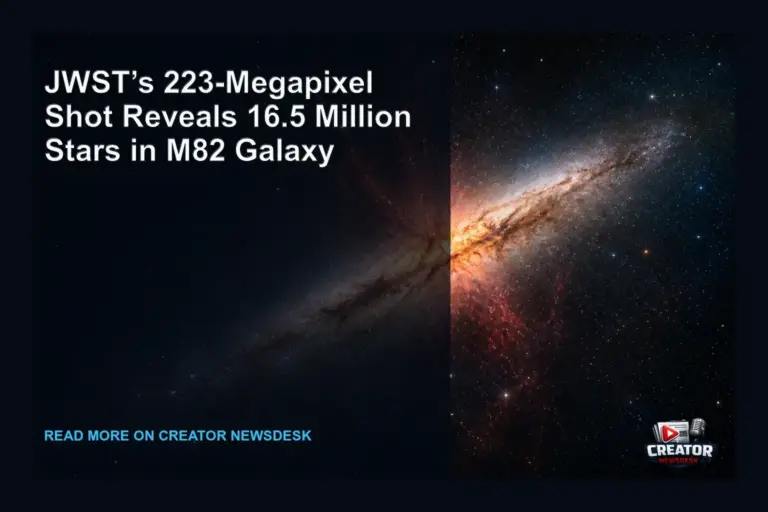
The James Webb Space Telescope (JWST) dedicated roughly three days—about 65 hours—to observing the spiral galaxy Messier 82, also known as the Cigar galaxy. This extended exposure allowed the observatory to collect an unprecedented amount of light from the distant stellar system.
The resulting image boasts a resolution of 223 megapixels, making it one of the highest‑detail photographs ever produced of a galaxy beyond the Milky Way. Within that vast frame, analysts have identified approximately 16.5 million individual stars, a figure that underscores the sheer density of stellar populations in M82’s star‑forming regions.
Beyond the star count, the data reveal brand‑new structural details that were not visible in previous observations. These include finer filaments of dust and gas, as well as subtle variations in the galaxy’s core that hint at ongoing dynamical processes. Such insights are valuable for researchers studying starburst galaxies and the mechanisms that drive intense bursts of star formation.
For content creators, the release offers a rich visual asset that can be used in educational videos, astronomy‑focused streams, or social‑media posts highlighting the capabilities of modern space telescopes. The image’s sheer scale and novelty provide a compelling talking point about how long‑duration observations with instruments like JWST continue to expand our understanding of the universe.
Published on June 25 2026, the photograph exemplifies the growing intersection of cutting‑edge science and digital media, giving creators a factual, awe‑inspiring resource to share with audiences interested in space exploration and astrophotography.
Join the conversation
Load Facebook comments to read and reply using your Facebook account.