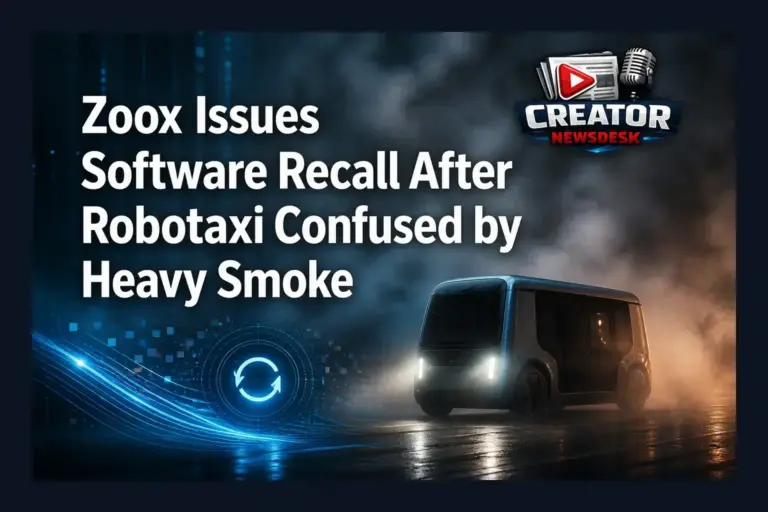
Zoox has issued a software recall for its robotaxi fleet after one of its vehicles became confused by heavy smoke during operation. The incident, reported on July 17, 2026, prompted the company to act swiftly to address a perception system flaw that impaired the vehicle’s ability to interpret environmental conditions correctly. While the source does not specify the exact nature of the confusion, the recall indicates a software-level issue affecting sensor interpretation or decision-making under obscured visibility conditions.
The move comes at a critical time, as the U.S. National Highway Traffic Safety Administration (NHTSA) has recently warned autonomous vehicle manufacturers about the risks of AVs interfering with first responders during emergency situations. Heavy smoke—often present at fire scenes or accidents—can obstruct sensors and challenge AI systems, potentially causing vehicles to halt unpredictably or misjudge surroundings, which may impede rescue operations.
For content creators covering autonomous technology, this event underscores the ongoing challenges in deploying AVs in complex, real-world environments. It highlights the importance of robust software testing under extreme conditions and the need for transparent communication when safety updates are issued. Zoox’s proactive recall reflects a growing industry focus on safety accountability, especially as regulators increase scrutiny on how self-driving vehicles interact with public safety protocols.
The incident also serves as a case study in ethical AI deployment, where perception failures in low-visibility scenarios could have real-world consequences beyond passenger safety. Creators covering tech, transportation, or urban innovation can use this development to explore how edge cases like smoke, fog, or debris are being addressed in AV training data and simulation pipelines. As the industry moves toward broader deployment, such recalls may become more frequent—making them newsworthy moments for audiences interested in the evolution of autonomous systems.
Zoox has not disclosed the number of vehicles affected or the timeline for the software update rollout, but the company confirmed the recall is voluntary and aimed at preventing recurrence. No injuries or accidents were reported in connection with the incident. The update will likely focus on improving object classification and motion prediction algorithms when visibility is reduced by particulates like smoke.
This story reinforces that while AV technology continues to advance, real-world unpredictability remains a significant hurdle—and how companies respond to these challenges shapes public trust and regulatory outcomes. For creators, it’s a reminder to follow not just the breakthroughs, but also the iterative improvements that define responsible innovation in the self-driving space.
Join the conversation
Load Facebook comments to read and reply using your Facebook account.
