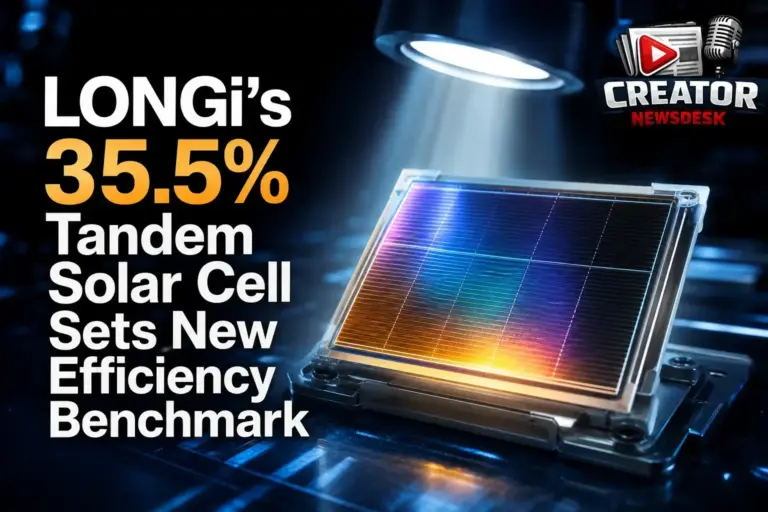
Chinese solar manufacturer LONGi has announced a breakthrough in photovoltaic technology, reporting a conversion efficiency of 35.5 percent for its new crystalline silicon-perovskite tandem solar cell. This achievement, confirmed through internal testing, represents one of the highest efficiencies recorded for this type of hybrid solar technology to date.
The tandem design combines traditional crystalline silicon with a perovskite layer, allowing the cell to capture a broader spectrum of sunlight. By stacking these materials, LONGi aims to overcome the efficiency limits of single-junction silicon cells, which typically max out around 26-27 percent in commercial applications.
This advancement holds significant implications for content creators and tech-driven industries reliant on sustainable power. Higher-efficiency solar cells mean more energy generation from smaller surfaces—ideal for powering mobile studios, outdoor production gear, or off-grid creative workflows. As solar integration expands into portable and building-integrated applications, such efficiency gains could reduce reliance on traditional power sources during remote shoots or events.
While LONGi has not yet disclosed commercial timelines or pricing for the technology, the milestone underscores China’s continued leadership in solar innovation. The company plans to further refine the tandem architecture for scalability and long-term stability, key factors for real-world deployment.
Industry analysts note that reaching 35.5 percent efficiency brings the technology closer to the theoretical limits of tandem cells, potentially accelerating adoption in both utility-scale and distributed solar markets. For creators investing in sustainable tools, this progress signals a future where high-performance, clean energy becomes more accessible and practical.
Join the conversation
Load Facebook comments to read and reply using your Facebook account.