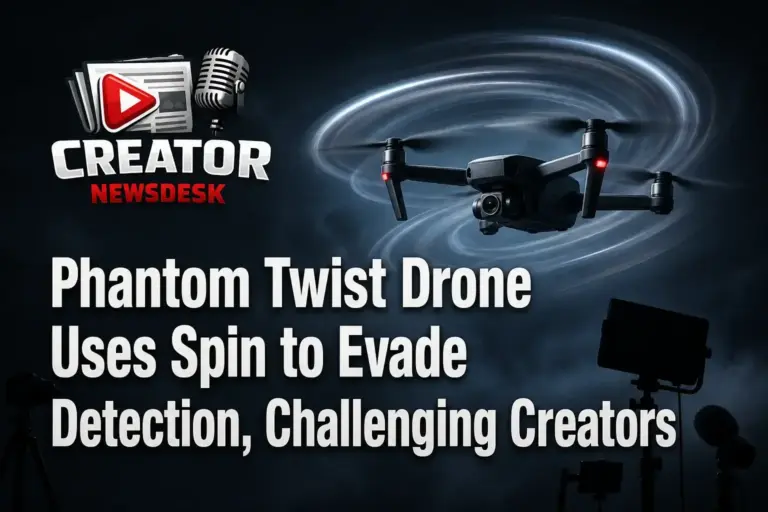
Researchers at Northwestern University have unveiled the Phantom Twist drone, a single-motor aircraft designed to exploit persistence of vision to reduce its visual detectability in flight. According to the university, the drone is approximately ten times harder to see than a conventional quadcopter of the same size when in motion. This effect is achieved through rapid spinning motion that blurs the drone’s form, making it challenging to detect with the naked eye or standard visual tracking systems.
The development introduces a new layer of complexity for drone detection technologies, which often rely on visual, auditory, or radar signatures to identify unmanned aircraft. For content creators who use drones for photography, videography, or live streaming, this advancement could signal future challenges in both operating stealthily and complying with airspace regulations that require visible identification.
While the Phantom Twist remains a research prototype, its implications extend to privacy, security, and responsible drone use. Creators operating in regulated environments may need to adapt to evolving detection standards as such technologies mature. The project underscores how innovations in flight dynamics can intersect with perceptual science to produce unexpected outcomes in unmanned aerial systems.
As drone usage grows across creative industries, staying informed about emerging technologies like the Phantom Twist helps creators anticipate shifts in both capability and oversight. Northwestern’s work highlights the ongoing tension between technological advancement and the need for accountability in shared airspace.
Join the conversation
Load Facebook comments to read and reply using your Facebook account.