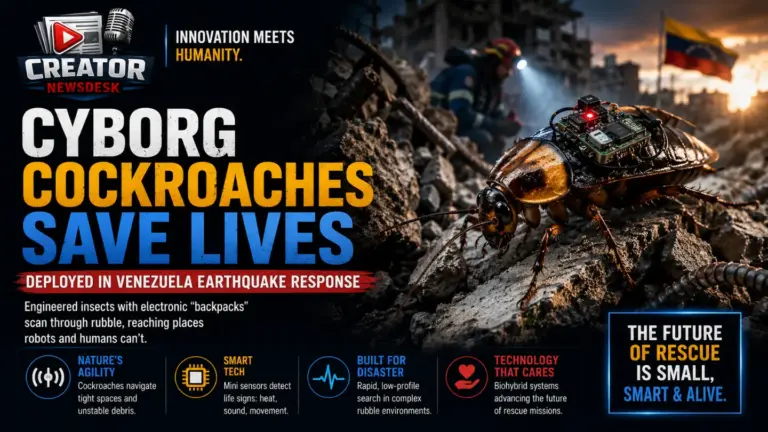
Cyborg cockroaches equipped with miniature electronic backpacks are being deployed to search through earthquake rubble in Venezuela, marking a significant step in the real-world application of biohybrid rescue technology. These insect-based systems leverage the natural agility of cockroaches to navigate narrow voids and unstable debris that are inaccessible to traditional wheeled robots or human rescuers.
The electronic backpacks carried by the insects contain sensors designed to detect signs of life, such as movement, heat, or sound, potentially helping locate survivors trapped beneath collapsed structures. This approach combines biological mobility with microelectronics to create a versatile tool for disaster scenarios where speed and access are critical.
The deployment in Venezuela follows years of laboratory development and testing, demonstrating how biohybrid systems are transitioning from experimental concepts to practical use in emergency response. Unlike conventional drones or ground robots, these cockroach-based platforms can squeeze through cracks as small as a few millimeters, expanding the reach of search teams in complex wreckage.
While the technology remains in early stages of field use, its application in Venezuela highlights a growing trend of integrating living organisms with engineered components to solve challenging problems in hazardous environments. For content creators focused on innovation, robotics, or humanitarian tech, this development offers a compelling example of how unconventional approaches can address real-world limitations in disaster relief.
As search operations continue, the performance of these biohybrid agents may inform future designs for urban search and rescue, potentially influencing how emergency teams prepare for and respond to seismic events in densely populated areas. The use of such adaptive, low-profile systems underscores the evolving role of biomimetic and bio-integrated tools in modern crisis response.
Join the conversation
Load Facebook comments to read and reply using your Facebook account.