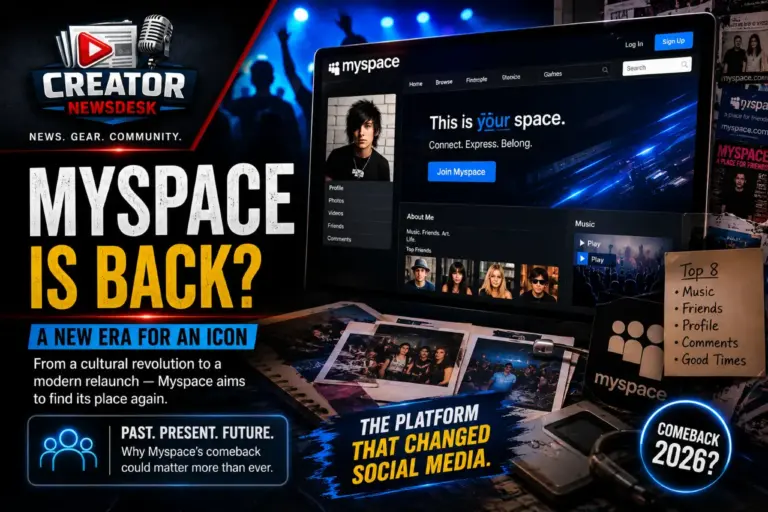
Myspace is trying to come back into the conversation again, and this time the pitch is landing in a very different social media environment.
The latest wave of attention follows Tommy Avallone’s documentary Myspace and fresh comments from people tied to the platform’s past and present. In a July 20, 2026 PEOPLE interview, Myspace co-founders Aber Whitcomb, Chris DeWolfe, and Tom Anderson reflected on how the platform changed social media. The same report said current owners Tim and Chris Vanderhook plan to relaunch the brand, though they did not give a public timeline or explain what the product would actually look like.
That missing detail matters. In 2026, “Myspace comeback” is a catchy headline. It is not yet a product strategy.
Why the story is getting traction now
Myspace still carries unusual cultural weight for creators because it represented an earlier version of internet identity. It was messy, customizable, music-heavy, and often less polished than the social platforms that followed. For a generation of creators, musicians, and early internet personalities, it was one of the first places where audience building felt direct and personal rather than optimized by a recommendation engine.
That nostalgia is part of the reason the comeback story is spreading. But the stronger reason is that the critique behind it feels current.
PEOPLE’s July 20 story focused on how Myspace’s founders view modern social media as more addictive than what they originally built. DeWolfe argued that today’s major platforms are shaped by algorithms designed to maximize time spent, while Myspace pushed users more toward music discovery and direct social interaction. RUSSH, in a July 22 follow-up, framed that contrast as part of the platform’s possible appeal now: if people are tired of algorithm-heavy feeds, a simpler and more expressive social product could sound attractive again.
That is the real Creator Newsdesk angle here. This is not just a retro brand revival story. It is a test of whether algorithm fatigue has become strong enough to create a real market opening.
What Myspace would have to solve
A comeback story is easy. A social graph rebuild is hard.
Even if there is real demand for a less manipulative platform, Myspace would still need to answer several practical questions:
1. Why would creators post there consistently instead of cross-posting occasionally for novelty?
2. How would audiences discover creators without the kind of recommendation systems the industry now depends on?
3. What would make the product feel current on mobile, not just retro on desktop?
4. How would the platform support creator business models such as subscriptions, tipping, fan clubs, ticketing, merch, or music promotion?
5. What would moderation and safety look like in a relaunch built around more personal expression and customization?
Those questions are bigger than branding. They go straight to distribution.
Myspace’s original rise happened in a far less saturated environment. PEOPLE noted that the platform once handled nearly 250,000 new user signups per day at its peak growth stage. That kind of momentum happened before today’s social ecosystem hardened around giants with entrenched creator tools, ad systems, messaging layers, and recommendation pipelines. A comeback now would not be competing only with Meta, TikTok, YouTube, and X. It would also be competing with habit.
The opening is real, but nostalgia is not enough
There is still a credible gap in the market.
Creators routinely complain that major platforms feel extractive, unstable, and increasingly hostile to direct audience relationships. Reach changes without warning. Feeds reward volume and short-term reactions. Discovery can be powerful, but it often comes at the cost of identity, ownership, and consistency. In that environment, a platform that promises more user control and less algorithmic pressure could get attention.
But attention is not adoption.
RUSSH correctly pointed out that there is no announced timeline and no real public detail on what a relaunch would include. That makes it difficult to evaluate whether Myspace is being rebuilt as a true social network, a music-centered community product, a nostalgia play, or simply a brand with optional future experiments attached to it.
That ambiguity is especially important because Myspace has already lived through unsuccessful revival attempts. The brand is famous enough to generate headlines on its own. That same fame can also make each relaunch feel larger than the underlying execution.
If Myspace wants to matter again, it probably cannot win by asking users to relive the old internet. It would need to solve a modern creator problem better than current platforms do.
What a viable relaunch could look like
The most realistic path is not “become Facebook again.” That opportunity is gone.
A smarter path would be to become a narrower platform built around things Myspace still evokes naturally:
- music discovery and fan communities
- creator identity and profile customization
- direct audience connection without over-engineered feeds
- a calmer social environment that feels less optimized for outrage and compulsion
If the relaunch leans into those strengths, Myspace could potentially carve out a meaningful niche. Not every platform needs to be universal to be useful. Some of the strongest creator tools in 2026 win precisely because they do one thing clearly.
Still, niche does not mean easy. A modern Myspace would need clear onboarding, strong creator incentives, and a reason for fans to check it regularly. It would also need to prove that “anti-algorithm” does not simply mean “hard to discover.”
Bottom line for creators
For now, creators should treat the Myspace comeback story as a signal, not a roadmap.
The signal is that dissatisfaction with mainstream social media has become strong enough that even a legacy brand like Myspace can re-enter the discussion with a serious narrative: maybe users want less manipulation, more personality, and more direct connection again.
The roadmap does not exist yet. As of Sunday, July 26, 2026, there is still no public launch date, no defined product vision, and no evidence that Myspace has solved the distribution and monetization problems that make or break social platforms for creators.
That means the headline is interesting, but the execution will decide whether this is a comeback, a niche experiment, or just another reminder that the social web still has unresolved demand for something better.
Join the conversation
Load Facebook comments to read and reply using your Facebook account.
