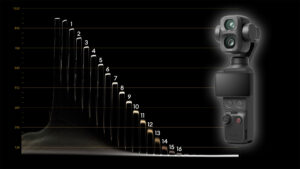
As a drone enthusiast who has watched DJI climb from consumer quadcopters to industry-defining imaging platforms, I've learned one thing: when DJI makes a bold spec claim, it's worth paying attention. The new Osmo Pocket 4P gimbal camera arrives with a headline-grabbing number — 17 stops of dynamic range on the wide camera. That's a figure that would put it in rarefied company, alongside far larger and pricier cinema tools.
Of course, claims are one thing. Verification is another. That's why CineD — known for its rigorous, methodical lab testing — decided to put the Pocket 4P through its paces. The team runs standard protocols to measure rolling shutter, dynamic range, and exposure latitude. When a manufacturer throws out a spec like 17 stops, the usual expectation is that real-world numbers will fall short, often significantly. But according to CineD's summary, the unbelievable has happened: the claim survived contact with the lab equipment.
For creators — and pilots like me who shoot aerial footage that feeds into ground-based projects — this matters more than bragging rights. High dynamic range is the difference between blowing out a sunset sky or retaining clouds and detail, between crushed shadows and a clean, filmic image. When a compact gimbal camera can hold highlight and shadow detail simultaneously, it reduces the need for ND filters, bracketing, or heavy post-production grading. That's pure workflow efficiency.
The lab test also examined rolling shutter, which is critical for anyone panning a gimbal or flying a drone. Excessive rolling shutter creates that wobbling "jello" effect on fast moves. CineD's inclusion of this metric suggests the Pocket 4P was evaluated as a serious motion imaging tool, not just a vlogging accessory. And the exposure latitude testing measures how much you can push and pull the image in post before it degrades — a key consideration for creators who want flexibility in grading.
The creator-business angle here is clear: DJI continues to iterate by pushing measurable performance boundaries in ever-smaller form factors. A lab-verified 17-stop claim in a pocket-sized gimbal camera signals that reliable, high-end imaging is no longer locked behind large, expensive rigs. For solo creators, drone operators, and documentary shooters, that's the kind of innovation that directly expands what's possible on a one-person production. CineD's full test promises details — and if the headline holds, it's a significant moment for compact camera tech.
