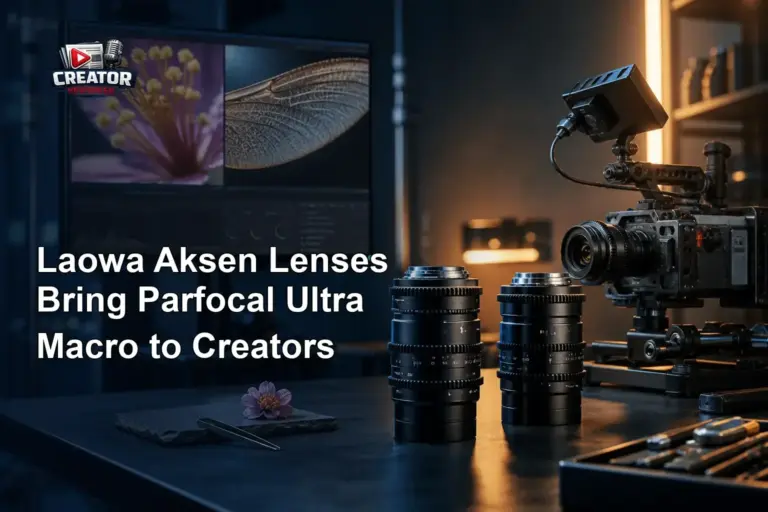
Venus Optics has officially announced the Aksen Ultra Macro Series, a new pair of full-frame lenses built for extreme close-up work. The lineup consists of the Laowa Aksen 45mm f/2.8 and the 17.5mm f/1.7, both described as parfocal lenses with ultra macro capabilities covering 1-5x and 5-10x magnification ranges, respectively.
For content creators, the headline feature here is the sheer magnification potential. Standard macro lenses typically stop at 1:1 life-size reproduction. The Aksen series pushes far beyond that, allowing creators to capture intricate details — from the weave of fabric and surface textures of food to the tiny solder points on a circuit board — without the need for complex focus stacking setups or additional extension tubes.
The parfocal design is arguably the most creator-friendly aspect of the announcement. In practical terms, parfocal lenses maintain focus as magnification changes, meaning a creator can smoothly push in from a wider shot to an extreme close-up without constantly re-focusing. This is a significant workflow advantage for product videographers, jewelry photographers, and any channel that relies on dramatic macro reveals or detailed inspection-style content.
As full-frame lenses, the Aksen series is positioned for use with professional mirrorless camera bodies, giving solo creators and small production teams a flexible tool for both photography and video work. The wide maximum apertures noted in the naming — f/2.8 and f/1.7 — suggest an emphasis on light gathering, though Venus Optics has not yet released detailed optical specifications or performance benchmarks.
As of the July 31, 2026 announcement, pricing, availability, and specific mount options for the Aksen Ultra Macro Series have not been confirmed. Creators who regularly produce macro-centric content should treat this as a development worth monitoring, particularly those who have previously relied on adapted microscope lenses or manual rail systems to achieve similar magnifications. The combination of parfocal operation and extreme macro range could fill a notable gap in the current lens market for serious close-up work.
Join the conversation
Load Facebook comments to read and reply using your Facebook account.
