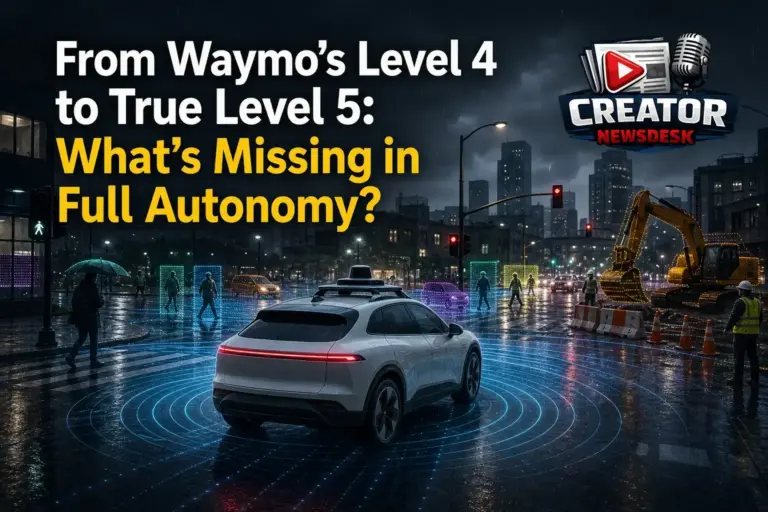
Waymo’s vehicles operating in select cities today are classified as Level 4 autonomous systems, meaning they can handle all driving tasks within specific geographic areas and conditions without human intervention. But true Level 5 autonomy—where a vehicle can operate anywhere, under any conditions, without a steering wheel or pedals—remains out of reach. The jump from Level 4 to Level 5 isn’t just incremental; it requires overcoming fundamental limitations in AI perception, decision-making, and real-world adaptability.
Level 4 systems rely on highly mapped environments, predictable weather, and controlled scenarios. Waymo’s success in Phoenix and San Francisco stems from extensive pre-mapping, sensor redundancy, and operational design domains (ODDs) that limit variables. Level 5, by contrast, demands the ability to navigate unmapped rural roads, extreme weather, construction zones, and ambiguous human behaviors—all without prior knowledge or geo-fencing.
Achieving this requires breakthroughs in generalizable AI models that can reason like a human driver, not just recognize patterns from training data. Current systems struggle with edge cases—rare but critical situations like a child chasing a ball into the street or a traffic officer directing flow contrary to signals. These scenarios are difficult to simulate at scale and impossible to exhaustively program.
For content creators in tech, AI, and automotive spaces, the Level 5 challenge represents a pivotal narrative: the gap between narrow AI and artificial general intelligence in real-world applications. While Level 4 enables scalable robotaxi services today, Level 5 would redefine personal transportation, logistics, and urban design—but only after solving problems that extend far beyond engineering into ethics, safety validation, and public trust. Until then, Level 4 remains the practical frontier.
Join the conversation
Load Facebook comments to read and reply using your Facebook account.