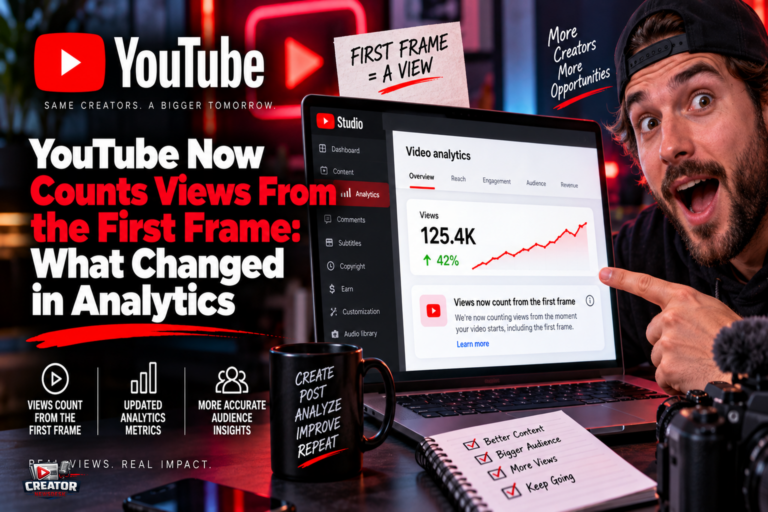
Since August 24, 2026, YouTube counts a view the moment a video starts to play, with no minimum watch time required. The change applies across long-form video, Shorts and live streams, and it means the public view counter now climbs faster than it did under the old definition.
The stricter old definition did not disappear. It survives inside YouTube Analytics under the name engaged views, which excludes replays and viewers who leave in the opening seconds. Monetization still runs on the strict numbers: Partner Program earnings come from engaged Shorts views and engaged watch hours, and eligibility still uses qualified views and qualified watch hours. The inflated public counter feeds neither revenue nor qualification.
What did change is every ratio with views in the denominator. Likes per view, comments per view and subscribers per view all dropped on the same day for channels that published nothing unusual, because the denominator grew while the numerators stayed put. Continuous live streams feel the effect most: a 24/7 broadcast collects a new view each time someone opens it, including viewers who watch four seconds and leave, so the counter on a long-running stream climbs far faster than it did in July.
The takeaway is to rebuild benchmarks on engaged views rather than public views. In Studio, compare current engaged view counts against pre-August baselines, recalculate conversion ratios with the stricter metric, and judge hooks on viewed-versus-swiped-away and retention rather than the headline counter. The public number is now a reach signal; the engaged number is the business signal.
Join the conversation
Load Facebook comments to read and reply using your Facebook account.
