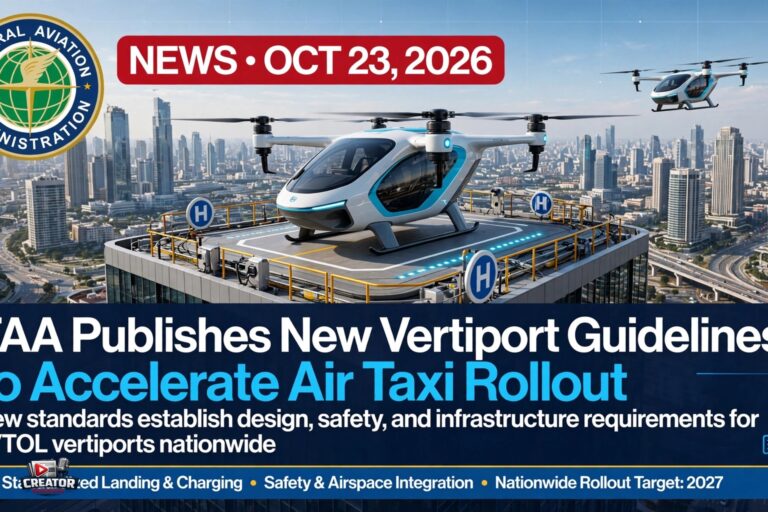
The Federal Aviation Administration has issued updated draft design standards for vertiports and vertical flight facilities, signaling progress toward commercial deployment of electric air taxis and other VTOL aircraft. Released on October 23, 2026, the guidance focuses on three core areas: safe landing and takeoff zones, infrastructure for electric charging or refueling, and seamless integration with existing airport operations. These standards aim to provide clarity for developers, municipalities, and aviation stakeholders building the foundational networks needed for urban air mobility.
For content creators covering transportation innovation, emerging tech, or smart cities, this update offers a concrete benchmark in an otherwise fast-moving sector. While the FAA’s document does not yet specify exact dimensions, power loads, or operational timelines, it establishes a federal framework that could influence state and local permitting, investment decisions, and public-private partnerships. Creators should note that vertiport design will directly affect where and how aerial ride services launch—impacting real estate, logistics, and media narratives around future cityscapes.
The agency emphasizes that these are draft standards, open to feedback before finalization. This creates an opportunity for creators to engage with experts, attend public comment periods, or highlight community perspectives on noise, safety, and equity in airspace access. As companies like Joby Aviation, Archer, and Lilium advance toward certification, vertiport readiness becomes a critical gating factor. Understanding these evolving standards helps creators anticipate rollout phases and explain complex infrastructure topics to audiences interested in the future of flight.
Beyond technical specs, the FAA’s move reflects broader momentum in advanced air mobility (AAM), where regulatory alignment often precedes commercial scale. By addressing airport integration specifically, the draft acknowledges that early vertiports may operate alongside conventional runways—requiring coordinated air traffic procedures. For creators, this intersection of legacy aviation and new technology presents rich storytelling potential: from pilot training adaptations to multimodal transit hubs reimagined for the skies. Monitoring how these standards evolve will be key to tracking when and where the first passenger flights begin.
Join the conversation
Load Facebook comments to read and reply using your Facebook account.
