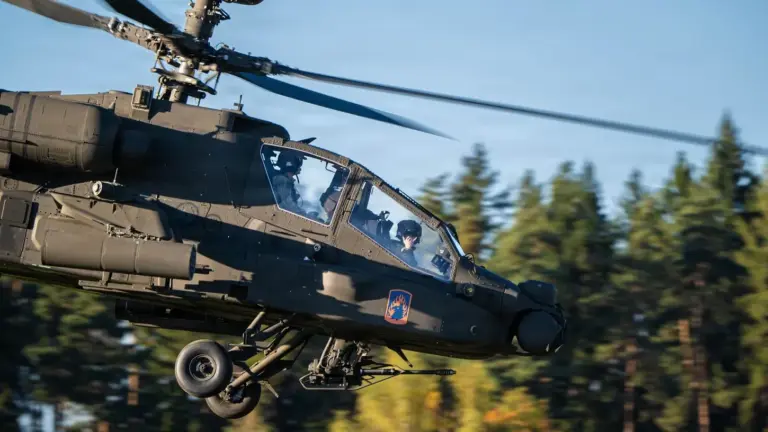
U.S. Army Apache helicopter crews recently conducted live-fire exercises targeting Shahed-style drones over Germany as part of the Skyfall II training event. According to reports from DroneXL dated October 26, 2026, the Apaches successfully engaged and downed target drones using cues from ground-based radar systems. The drills simulated real-world scenarios involving loitering munitions similar to those used in current conflicts.
The exercise highlights ongoing efforts by Western militaries to counter the growing threat of inexpensive, high-volume attack drones. Apaches, equipped with advanced sensors and precision weapons, remain a key platform for air defense in contested environments. However, the same report notes a significant limitation: newer variants of Russia’s Geran-4 drone—derived from Iranian Shahed designs—are now flying faster than the Apache helicopter can effectively pursue.
This speed disparity presents a tactical challenge for rotary-wing aircraft tasked with intercepting fast-moving, low-altitude threats. While Apaches can still engage within certain parameters using predictive targeting and radar handoffs, their ability to chase down quicker drones mid-flight is increasingly constrained. The development underscores a broader trend in drone evolution where propulsion and guidance improvements are outpacing legacy air defense platforms.
For content creators in the defense, aerospace, and drone technology sectors, this scenario offers a compelling case study in asymmetric warfare dynamics. It illustrates how rapid iteration in unmanned systems can shift the balance of power, even against formidable manned assets. As drone capabilities advance, militaries may need to rely more on integrated air defense networks—combining ground radars, electronic warfare, and faster interceptors—rather than depending solely on helicopter-based responses.
The Skyfall II exercise serves as a data point in evaluating current counter-drone strategies. Though specific performance metrics or engagement ranges were not disclosed in the source, the outcome emphasizes the importance of layered defense approaches. Creators covering future conflict tech should monitor how armed forces adapt platforms and tactics to address the evolving speed and endurance of loitering munitions like the Geran-4 and its successors.
Join the conversation
Load Facebook comments to read and reply using your Facebook account.
