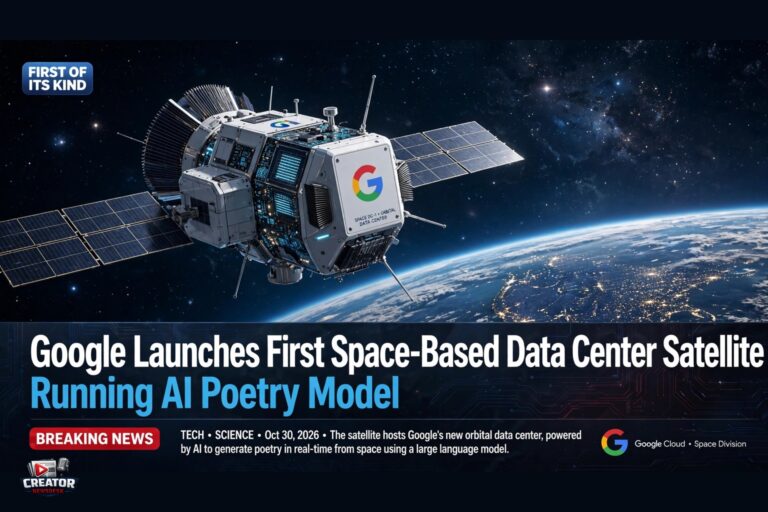
Google has activated its first data center in space, marking a significant step in off-world computing infrastructure. The satellite, launched as part of Google’s orbital computing initiative, hosts a Tensor Processing Unit (TPU) running a version of the Gemma 4 large language model developed by Google DeepMind. According to TechCrunch, the system is currently online and generating poetry — described as "cheesy" but functional — demonstrating the viability of AI workloads in low Earth orbit.
This deployment represents a novel use case for space-based AI: testing model performance under unique environmental conditions like radiation exposure, thermal variance, and limited bandwidth while maintaining real-time inference capabilities. For content creators, the experiment signals growing access to distributed AI compute beyond terrestrial data centers, potentially enabling future applications in remote sensing, live media processing, or AI-driven storytelling tools powered by orbital nodes.
While the poetic output is primarily a proof-of-concept, it underscores Google’s strategy of pushing AI to extreme environments to harden systems and explore new frontiers in scalable, decentralized computing. The Gemma 4 model, known for its efficiency and open-weight design, is well-suited for such constrained environments, balancing performance with power and thermal constraints inherent to satellite platforms.
No official details have been released regarding the satellite’s altitude, launch vehicle, or mission duration. However, the successful operation of a TPU-backed LLM in orbit validates years of research into space-hardened accelerators and lays groundwork for future constellations capable of supporting generative AI, real-time translation, or immersive content creation from space.
For creators exploring AI-assisted workflows, this development hints at a future where geographic and infrastructural limits no longer constrain where — or how — intelligent content is generated. As orbital edge networks evolve, they may offer low-latency, resilient alternatives for AI-driven creativity, especially in underserved or disaster-affected regions. Google’s poetry-writing satellite may seem whimsical today, but it could be an early stanza in a much larger story about AI’s reach beyond Earth.
Join the conversation
Load Facebook comments to read and reply using your Facebook account.
