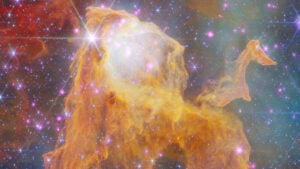
NASA’s Chandra X-ray Observatory and the James Webb Space Telescope (JWST) have captured a striking celestial formation in the Carina Nebula that resembles a ghostly figure—a fitting sight as Halloween approaches. The combined data reveals a dense cloud of gas and dust with a rounded head and a long, curved tail, evoking the silhouette of a hooded specter drifting through deep space. This ethereal shape emerges from the interplay of stellar winds and radiation sculpting the nebula’s interstellar material.
The Carina Nebula, located about 7,500 light-years from Earth, is one of the most active star-forming regions in our galaxy. It hosts massive young stars whose intense energy carves intricate structures in the surrounding clouds. Chandra’s X-ray vision highlights high-energy emissions from these stars, while JWST’s infrared sensitivity penetrates dust to reveal cooler gas and nascent stars hidden within. Together, they provide a multi-wavelength view that brings such cosmic pareidolia to life.
For content creators, this discovery offers more than just a spooky seasonal anecdote—it’s a powerful visual metaphor. The ghost-like cloud exemplifies how natural cosmic processes can produce familiar, almost artistic shapes, sparking ideas for concept art, storytelling, and immersive digital environments. Astrophotographers and VFX artists alike can draw inspiration from the real-world textures and lighting dynamics observed in such nebulae.
While the image itself isn’t new raw data, its timely release ahead of October 31st serves as a reminder of how space imagery continues to fuel creative industries. As telescopes like Chandra and JWST peer deeper into the universe, they don’t just expand scientific understanding—they also enrich the visual language available to designers, filmmakers, and world-builders seeking authentic, awe-inspiring aesthetics rooted in real cosmic phenomena.
Join the conversation
Load Facebook comments to read and reply using your Facebook account.
