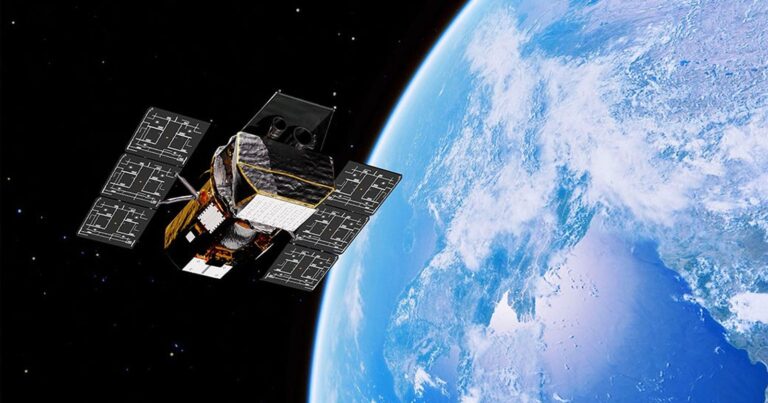
NASA’s Neil Gehrels Swift Observatory, a 3,200-pound space telescope that has monitored high-energy cosmic events for over two decades, is expected to re-enter Earth’s atmosphere on November 4, 2026. The agency confirmed the descent will occur tomorrow, marking the end of a long-running mission dedicated to studying gamma-ray bursts and black hole activity.
While most of the observatory is expected to burn up during atmospheric re-entry, NASA acknowledges that certain dense components may survive the descent and reach the planet’s surface. These remnants could pose a minimal risk to people or property, though the agency emphasizes the likelihood of harm remains extremely low due to the vast uninhabited areas covering Earth’s surface.
The Swift Observatory launched in 2004 and has played a critical role in advancing astrophysics by rapidly detecting and directing follow-up observations of transient cosmic phenomena. Its data has been widely used by researchers and educators alike, contributing to numerous scientific breakthroughs and public outreach efforts in astronomy and space science.
For content creators focused on science, technology, or space exploration, this event underscores the real-world lifecycle of orbital assets and the growing conversation around responsible space operations. As more satellites age and deorbit, understanding re-entry risks becomes increasingly relevant for both technical accuracy and public engagement in space-related narratives.
NASA will continue tracking the observatory’s trajectory and provide updates if necessary. No specific impact zone has been predicted at this time, and the agency maintains that uncontrolled re-entries of this nature are routine, with casualties being statistically improbable. Further details will be shared as the event unfolds.
Join the conversation
Load Facebook comments to read and reply using your Facebook account.
