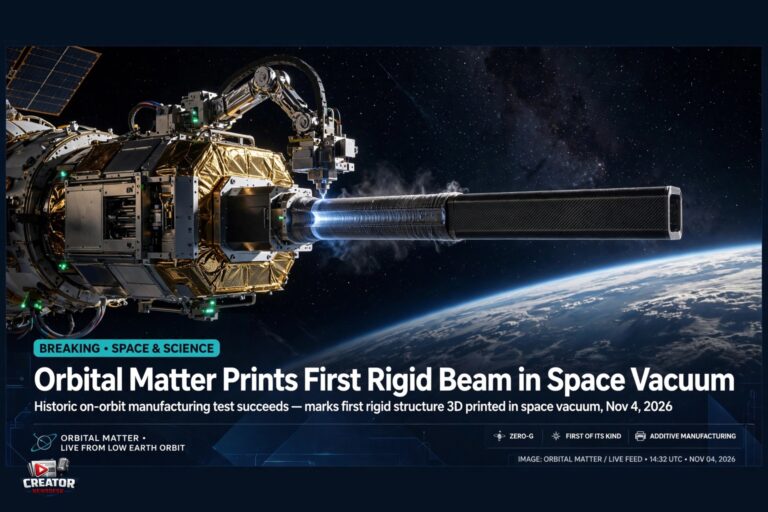
On November 3, 2026, Orbital Matter announced it successfully 3D printed the first rigid structural beam in the vacuum of space, marking a significant advancement in off-Earth manufacturing capabilities. The demonstration, conducted outside a spacecraft or space station, proves that additive manufacturing can produce load-bearing components without atmospheric pressure—a critical requirement for building large-scale infrastructure in orbit. This achievement addresses one of the core challenges of in-space construction: creating durable, precision parts in microgravity and vacuum conditions where traditional fabrication methods fail. By validating the process in actual space environments, Orbital Matter moves beyond lab simulations to real-world applicability. The ability to print rigid beams in space opens pathways for assembling larger structures such as habitats, solar arrays, and potentially orbital data centers—facilities that could process satellite data closer to the source, reducing latency and reliance on ground-based systems. While the company did not disclose specific dimensions, materials, or printer specifications for the beam, the focus remains on the feasibility of structural production in space. For content creators and tech innovators, this development signals growing momentum behind the orbital economy, where manufacturing in space could reduce launch costs and enable scalable, sustainable infrastructure beyond Earth. As interest in space-based computing and storage grows, breakthroughs like this lay the technical foundation for future commercial platforms operating independently in low Earth orbit. Orbital Matter’s progress reflects a broader trend toward self-sufficient space operations, where raw materials may one day be sourced from asteroids or lunar regolith, and finished products are built entirely off-planet. Though still early, this milestone reinforces the viability of long-term orbital industry—and the role of advanced manufacturing in shaping it. Creators watching the intersection of aerospace, hardware innovation, and digital infrastructure should note how such advances could eventually support new forms of space-enabled content delivery, edge computing, and immersive experiences powered by orbital nodes.
Join the conversation
Load Facebook comments to read and reply using your Facebook account.
