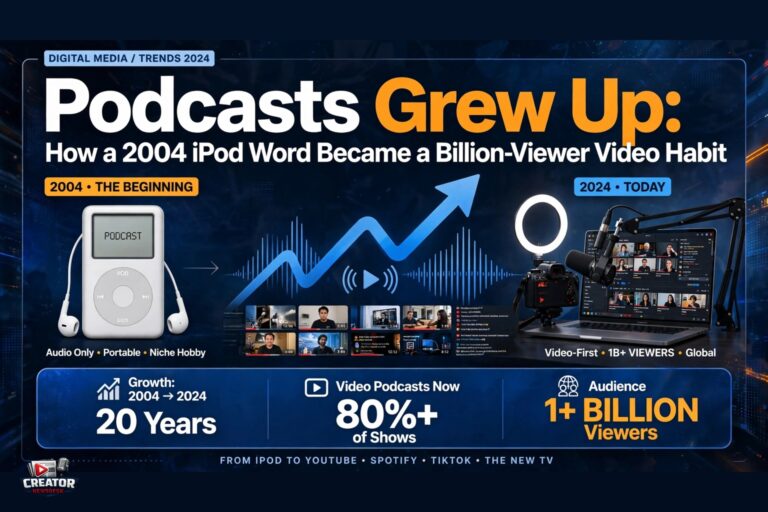
Every creator working today inherited a word that was invented almost by accident. A podcast is a program made available in digital format for download over the Internet, and the name itself is a portmanteau of “iPod” and “broadcast”, coined in 2004. Two decades on, the medium the word describes has quietly become one of the main stages a creator can stand on, and it no longer belongs to audio alone.
A name from a newspaper column
The earliest use of “podcasting” was traced to The Guardian columnist and BBC journalist Ben Hammersley, who coined it in early February 2004 while writing an article for The Guardian. The term was first used in the audioblogging community in September 2004, when Danny Gregoire introduced it in a message to the iPodder-dev mailing list, from where it was adopted by podcaster Adam Curry. Despite the etymology, the content can be accessed using any computer or similar device that can play media files, and the term “podcast” predates Apple’s own addition of podcasting features to the iPod and iTunes.
The plumbing came before the name
The distribution idea is older than the label. In October 2000, the concept of attaching sound and video files in RSS feeds was proposed in a draft by Tristan Louis, and the idea was implemented by Dave Winer, a software developer and an author of the RSS format. Podcasting is still, at its core, the preparation and distribution of audio or video files using RSS feeds to the devices of subscribed users. A podcaster normally buys hosting from a podcast hosting company, and hosting companies then distribute the media files to podcast directories and streaming services such as Apple, Spotify, and YouTube. In August 2004, Adam Curry launched his show Daily Source Code, and in June 2005 Apple released iTunes 4.9, which added formal support for podcasts and removed the need for a separate program to download and transfer them to a mobile device.
Why the barrier stayed low
The form is acclaimed for its low overhead for creators to start and maintain podcasting, merely requiring a microphone, a computer or mobile device, and associated software to edit and upload the final product, with some form of acoustic quieting also often used. The cost to the consumer is low as well, and many podcasts are free to download; some are underwritten by corporations or sponsored with commercial advertisements, while others run on a paid subscription model, advertising, or product delivered after sale. Because podcast content is often free, podcasting is often classified as a disruptive medium, adverse to the maintenance of traditional revenue models.
The video turn
Podcasts are primarily an audio medium, but in the mid-2020s video podcasts, either as primary content included in the feed or as an external supplement to audio, have been popularized. In 2025, Bloomberg reported that a billion people were watching podcasts on video platform YouTube every month. That shift cuts both ways: it can cause issues where the audio-only experience suffers when something is shown to viewers in a manner that is not apparent to audio listeners. The scale is real either way. As of August 2026, the Podcast Index listed about 4.7 million podcast feeds, of which about 438,000 had published an episode in the previous 90 days. The lesson for creators is in that second number: the feed count is enormous, the active count is a tenth of it, and the medium still rewards the people who simply keep publishing.
Sources
- Wikipedia: Podcast
Join the conversation
Load Facebook comments to read and reply using your Facebook account.