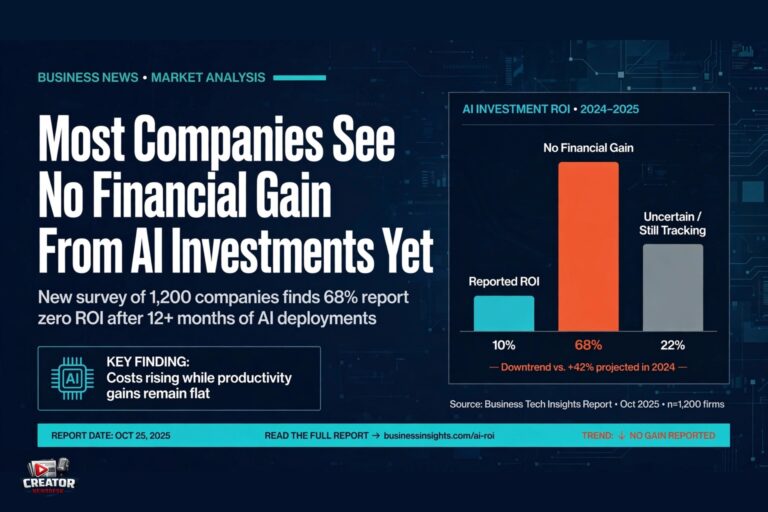
A recent analysis by an Apollo economist reveals that despite widespread adoption and significant spending, artificial intelligence has delivered no measurable financial payoff to most U.S. companies outside the technology sector. The finding challenges the prevailing narrative that AI automatically drives efficiency, revenue growth, or cost savings across industries.
For content creators and digital entrepreneurs, this insight is particularly relevant. Many have invested time and resources into AI-powered tools for editing, analytics, audience targeting, and automation, often under the assumption these would translate into direct financial returns. The data suggests such expectations may be premature—or misplaced—for those not operating within core tech ecosystems.
The economist’s assessment underscores a growing gap between AI’s promotional potential and its real-world economic impact in mainstream business. While AI continues to attract venture capital and media attention, actual profitability gains remain elusive for sectors like retail, manufacturing, and services—areas where many creator-adjacent businesses operate.
This doesn’t mean AI lacks value entirely. Instead, it signals a need for more strategic implementation. Creators should evaluate whether their AI tools are solving specific workflow problems or simply following trends. Measuring outcomes—such as time saved, engagement lift, or conversion improvements—becomes critical when financial returns aren’t guaranteed.
As the AI market matures, the focus may shift from experimentation to accountability. For now, creators are advised to treat AI as a productivity aid rather than a profit engine, closely tracking performance to avoid sunk costs on overhyped solutions. Continued scrutiny will be essential as investment levels remain high amid uncertain returns.
Join the conversation
Load Facebook comments to read and reply using your Facebook account.
