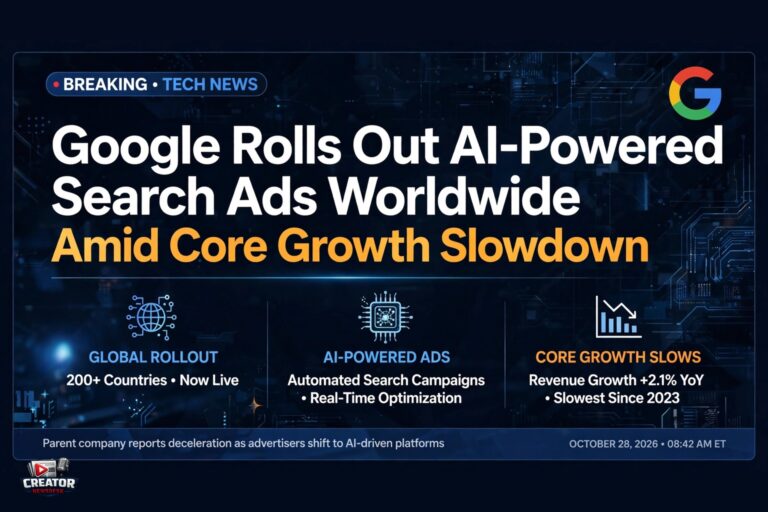
On October 28, 2026, Google announced the global expansion of its AI-powered Search ads, coinciding with Alphabet’s third-quarter earnings report showing a 25% year-over-year revenue increase to $127.6 billion. While overall revenue rose strongly, the move highlights growing reliance on artificial intelligence to sustain momentum in its core advertising business, which has shown signs of slowing growth.
The rollout brings generative AI capabilities to Search ad formats across international markets, enabling more dynamic ad creation, improved targeting, and real-time optimization based on user intent signals. This advancement aims to help advertisers—including content creators and small businesses—produce more relevant ads without requiring deep technical expertise in campaign management.
For creators who rely on search visibility to drive traffic to blogs, videos, or affiliate links, the update offers potential advantages in reaching niche audiences through contextually aligned placements. By automating aspects of ad copy generation and bidding strategy, Google seeks to lower barriers to entry while maintaining performance standards in competitive verticals.
Industry observers note that as traditional keyword-based ad growth plateaus, AI integration becomes critical for scaling efficiency and ad relevance at scale. Google’s shift reflects broader industry trends where automation and machine learning are being deployed to counter maturation in digital ad markets. Creators should monitor how these changes affect cost-per-click rates and conversion performance in their campaigns over the coming quarters.
While specific pricing or feature details were not disclosed in the announcement, the global availability signals a long-term commitment to embedding AI into the foundation of Google’s ad ecosystem—an evolution that could reshape how creators approach paid promotion in an increasingly automated landscape.
Join the conversation
Load Facebook comments to read and reply using your Facebook account.
