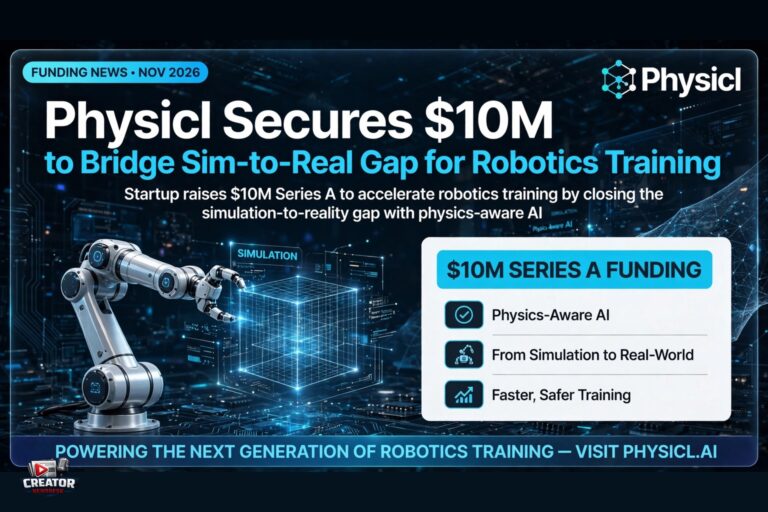
Physicl has raised $10 million in funding to advance its technology aimed at closing the sim-to-real gap in robotics—a critical challenge where virtual training fails to translate effectively to physical environments. The company’s approach leverages a pipeline initially developed for marketing goods online, repurposing high-fidelity 3D modeling and rendering techniques used in e-commerce product visualization to create more realistic digital training grounds for robots. This adaptation allows robotic systems to learn complex manipulation tasks in simulated settings that closely mirror real-world physics and object interactions. For content creators working at the intersection of AI, automation, and immersive media, Physicl’s model highlights how tools from digital commerce can be reengineered to serve advanced robotics development. By improving the fidelity of virtual environments, the platform aims to reduce reliance on costly and time-consuming physical prototyping, accelerating innovation cycles. The funding round underscores growing investor confidence in infrastructure that enables safer, more scalable robot training—particularly valuable as demand increases for adaptable automation across logistics, manufacturing, and service industries. Creators involved in AI content pipelines may find parallels in how synthetic data generation and environment design are evolving to support real-world performance. While specific technical benchmarks or partnership details were not disclosed in the announcement, the core value proposition centers on transferring visual and interactive fidelity from consumer-facing digital experiences into functional training simulators. This cross-disciplinary application reflects a broader trend where creator-grade tools are being adapted for industrial AI use cases, offering new opportunities for collaboration between media technologists and robotics engineers. As the sim-to-real challenge remains a bottleneck in deploying autonomous systems, solutions like Physicl’s could play a pivotal role in making robotics more accessible and effective for next-generation applications. Continued progress in this space may also open avenues for creators to contribute expertise in 3D asset creation, scene composition, and physics-based rendering—skills increasingly relevant beyond entertainment and into functional AI ecosystems.
Join the conversation
Load Facebook comments to read and reply using your Facebook account.
