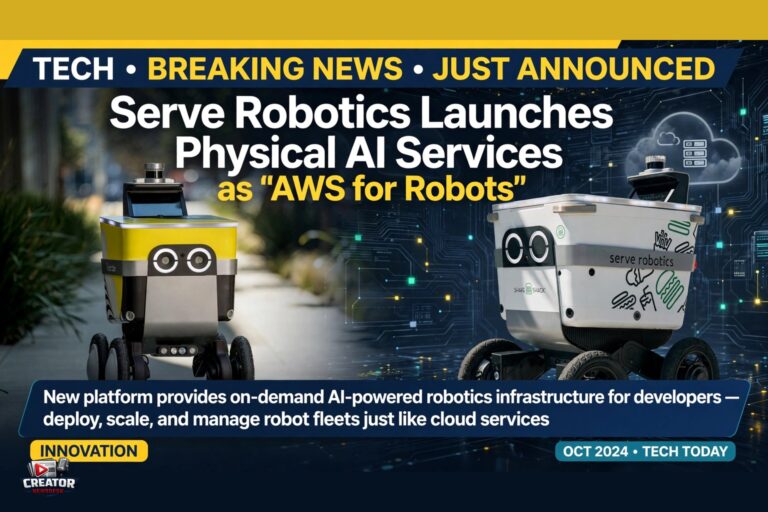
Serve Robotics has announced the launch of Physical AI Services, a new business unit designed to offer other companies access to its proprietary connectivity platforms and data management tools used in autonomous delivery operations. The initiative was revealed alongside the company’s third-quarter 2026 earnings report on November 5, 2026, signaling a strategic shift from pure robot deployment to enabling broader robotic ecosystems through software and infrastructure support.
By framing Physical AI Services as an “AWS for robots,” Serve Robotics aims to position itself as a foundational layer for robotics innovation—providing the backend systems that allow third-party developers to build, monitor, and scale intelligent machines without constructing their own data pipelines or network layers. This mirrors how Amazon Web Services empowered startups by offering scalable cloud computing, now applied to the physical world of robotics.
For content creators leveraging automation in logistics, retail, or smart environments, this development opens new pathways to integrate robotics into workflows without needing deep engineering expertise in real-time sensor fusion or edge computing. Serve’s platform could streamline tasks like automated filming rigs, interactive installations, or dynamic set modifications in media production, where reliable robot-to-cloud communication is essential.
The move reflects growing demand for interoperable robotics infrastructure as industries adopt fleets of semi-autonomous units requiring centralized oversight, diagnostics, and fleet learning. Rather than selling robots alone, Serve is monetizing its accumulated operational intelligence—gleaned from years of sidewalk delivery deployments—to help others avoid common integration pitfalls.
While specific pricing tiers, API details, or partner commitments were not disclosed in the announcement, the core value proposition centers on reducing time-to-deployment for robotics applications by offering pre-built, secure, and scalable connectivity and data services. Creators exploring embodied AI or spatial computing projects may find this infrastructure layer particularly relevant as they seek to bridge digital creativity with physical execution.
Serve Robotics’ pivot underscores a maturing robotics market where enabling technology—rather than hardware alone—becomes a key differentiator. For innovators building the next generation of responsive, data-driven experiences, access to robust robotics plumbing could be as vital as the bots themselves.
Join the conversation
Load Facebook comments to read and reply using your Facebook account.
