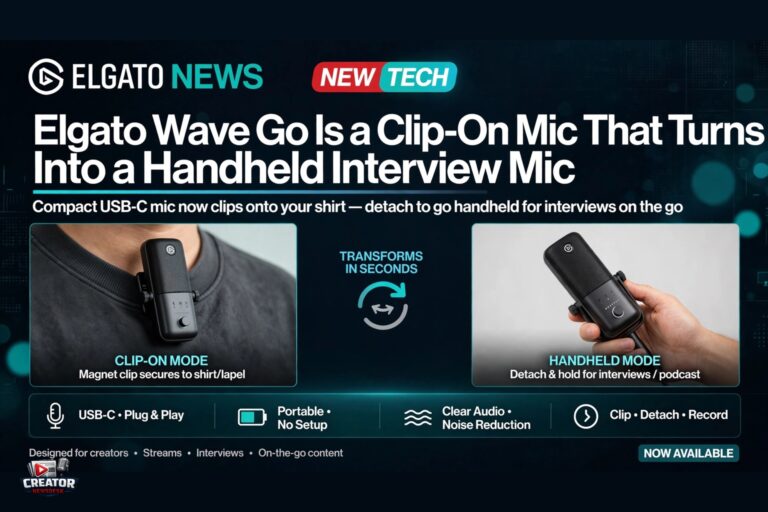
Elgato has spent years selling desk microphones to streamers. This month the company shipped its first wireless mic, and it is aimed at a different kind of creator day. The Wave Go, launched in October 2026 at $99.99, is a convertible wireless microphone that works two ways: clipped to a shirt for hands free recording, or slotted into an included Smart Handle to become a handheld interview mic. One kit, one USB-C receiver, and no second microphone to buy when the shoot changes from a solo walk and talk to a street interview.
That switch is the whole pitch. The transmitter is tiny, weighing 7 grams, and Elgato describes it as about the size of a coin. In clip-on mode it mounts magnetically to clothing, with a magnetic plate and clip in the box, plus two furry windscreens for outdoor work. When a handheld makes more sense, the same transmitter drops into the Smart Handle, which adds grip, integrated controls, and a sound profile tuned for close up voices. Elgato says switching between the two modes takes seconds, and the case has room for the transmitter, handle, receiver, and even a second mic.
Processing does the level riding for you
Wave Go uses an electret condenser capsule with an omnidirectional pattern, recording at 48 kHz and 24 bit. The more interesting part is what happens after the capsule. A feature Elgato calls EQ Shift applies a different sound profile for each mode, matching the tone to where the mic actually sits, on a chest or up close in a hand. Auto Gain keeps levels steady in real time, a limiter smooths sudden peaks, and a low cut filter removes low end rumble. A button on the receiver toggles noise cancellation for louder locations. Creators who want manual control get it through the free Wave Go app for iOS and Android, which handles adjustable gain, noise cancellation settings, and battery monitoring.
The wireless link is a dedicated 2.4 GHz connection to the USB-C receiver, not Bluetooth. Elgato lists latency at 24 milliseconds or less and a range of about 30 meters, or 100 feet. Bluetooth is used only to connect the companion app for settings and updates. That distinction matters for live work: the audio path is built for low latency recording into a phone or computer, while the phone in your other hand stays free for the app.
Battery math built for a full shoot day
The transmitter runs about eight hours on a charge. The Smart Handle carries a 900 mAh battery that recharges the transmitter whenever it is docked, even while recording, and Elgato says the handle can fully charge the transmitter about five times. Launch coverage put total system runtime at up to 48 hours. A quick charge of about ten minutes returns roughly an hour of use. The carrying case recharges the transmitter and handle together over USB-C, and the receiver supports pass through charging, so a phone can stay powered during a long recording or live session.
Back at a desk, the same mic keeps working. Elgato positions Wave Go as a lightweight option for video calls, voice work, podcasting, online teaching, and streaming, with Wave Link software support on Windows 11 and macOS 15 or newer. For creators whose desk mic and field mic are currently two separate purchases, that double duty is where the $99.99 price starts to make sense.
The limits are clear, and worth reading before you buy
Wave Go is a phone and computer mic, full stop. Elgato states plainly that it is designed for USB-C devices and is not made for direct use with professional cameras such as a DSLR or mirrorless body. Older iPhones with a Lightning port are not supported. It also does not record audio onboard. Sound goes straight to the connected phone or computer, so there is no backup file on the transmitter if a wireless link drops. Creators who treat onboard backup recording as non negotiable will need a different system, and Elgato itself says so in its FAQ.
The kit includes one transmitter. Interviews with two mic’d speakers mean adding a second transmitter, sold separately as an add on. None of that undermines the core idea. The wireless mic market has spent two years racing to make transmitters smaller and cheaper, mostly as clip-on only products, a race The Verge framed on launch day as Elgato taking on DJI. Wave Go instead asks a workflow question: how often does a creator carry a handheld mic they wish they had, and a clip-on they are already wearing? For phone first creators who shoot story times, street interviews, and hour long lives with one hand, one $99.99 kit now answers both.
Sources
Elgato, Wave Go product page (price, kit contents, tech specs, FAQ), fetched October 31, 2026: https://www.elgato.com/us/en/p/wave-go
Gavin Sheehan, Bleeding Cool, “Elgato Launches The New Wireless Wave Go Convertible Microphone,” October 19, 2026: https://bleedingcool.com/tech/elgato-launches-the-new-wireless-wave-go-convertible-microphone/
Launch day coverage, October 13, 2026, via Google News: The Verge, “Elgato takes on DJI with a tiny wireless mic for creators on the go”; StreetInsider, “Elgato launches Wave Go, a $99.99 wireless mic for mobile creators”; Corsair announcement via Investing News Network, “CORSAIR Enters Fast Growing Mobile Recording Market with New Elgato Wireless Microphone.”
Join the conversation
Load Facebook comments to read and reply using your Facebook account.
