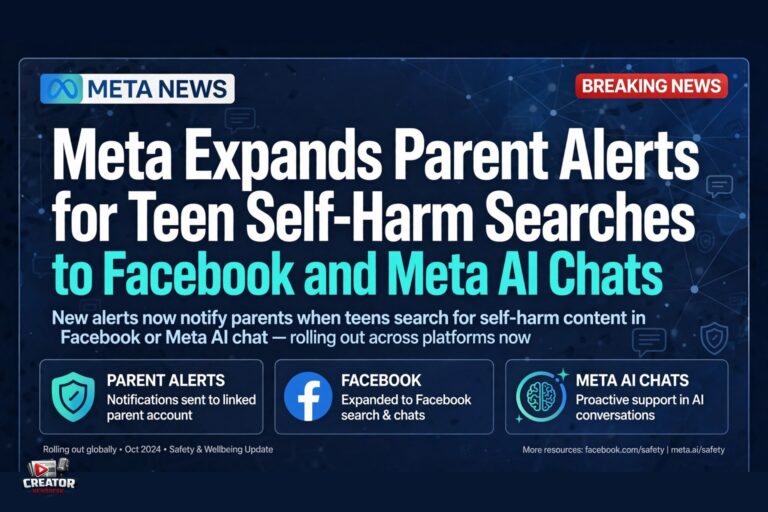
Meta is widening one of its most sensitive safety systems. In an update posted on October 29, 2026, the company said it is rolling out parent alerts for teen searches on Facebook, and for teen conversations with Meta AI on Facebook and Messenger. Supervising parents around the world will now be notified in two situations: if their teen repeatedly searches for suicide or self-harm terms on Facebook or Instagram within a short period of time, or if a conversation with Meta AI across Facebook, Instagram, or Messenger suggests the teen may be at risk of suicide or self-harm.
The alerts began on Instagram. Meta first announced them on February 26, 2026, saying Instagram would notify parents using supervision when a teen repeatedly tried to search for terms related to suicide or self-harm. The rollout reached the EU, Brazil, and India in May, and Meta said in August that the Instagram alerts were available to supervising parents globally. The October update closes two gaps in that system. Facebook searches now count alongside Instagram searches, and the net extends beyond search into the chats teens have with Meta AI itself.
How the alerts work
Meta says attempted searches that can prompt an alert include phrases promoting suicide or self-harm, phrases that suggest a teen wants to harm themselves, and direct terms such as “suicide” or “self-harm.” A single search is not the trigger. The company says it chose a threshold that requires a few searches within a short period of time, while still erring on the side of caution. When the threshold is met, parents receive an alert by email, text, or WhatsApp, depending on the contact information Meta has, along with an in-app notification. Tapping it opens a full-screen message explaining what was detected, with expert resources designed to help parents approach a sensitive conversation with their teen.
What the alert does not contain matters as much as what it does. As Engadget reported on October 29, the notifications do not detail the specific search terms a teen used or the contents of a Meta AI chat. Meta has also stayed deliberately vague about the exact criteria that trigger an alert, and it acknowledges the balance it is trying to strike. Alert too rarely and a parent who could help never hears anything. Alert too often and families stop taking the notices seriously. Meta says it analyzed Instagram search behavior and consulted its Suicide and Self-Harm Advisory Group before setting the threshold, and it accepts that it may sometimes notify parents when there may not be real cause for concern.
The alerts sit on top of restrictions that were already in place. Meta blocks searches for terms clearly associated with suicide and self-harm, showing no results and instead directing people to resources and local helplines. Content that promotes or glorifies suicide or self-harm is banned outright, and personal stories about these struggles, while allowed for adults, are hidden from teens even when someone they follow shares them. The June 2026 Teen Accounts update also expanded the list of blocked search terms for teens to include coded language and common misspellings, and moved every teen on Facebook into a Teen Account.
Why creators should pay attention
This is a safety story, but it is also a platform policy story that reaches working creators in three ways. First, a large share of the creator economy runs on teen audiences and teen creators. Supervision is now the default frame for those accounts on Facebook and Instagram, and features like these alerts only work when a parent is enrolled. Creators building for young audiences should expect more of the experience to be mediated by a parent dashboard, not less.
Second, mental health creators sit closest to the line this system draws. Content about personal recovery can remain up for adult audiences while being hidden from teens, and the search terms audiences use to find help are the same terms that can trigger a parent alert when repeated. Creators in this space should keep doing what the policy already rewards: lead with support resources, avoid any framing that could read as promotion, and remember that in the United States, anyone in crisis can call or text 988 to reach the Suicide and Crisis Lifeline.
Third, Meta AI is now part of the safety perimeter, not just a creative tool. Many creators use Meta AI inside Messenger and Facebook to brainstorm, draft, and answer messages. For teen accounts, those same conversations are screened for signs of risk, and a flagged chat can produce a parent notification without revealing the chat itself. Anyone advising young creators should make sure they understand that an AI chat on a supervised teen account is not a private diary.
Meta calls this a starting point and says it will keep monitoring feedback. For creators, the direction is clear enough. Teen safety controls on Meta platforms are expanding from content filters into active notifications, and from search boxes into AI conversations. The audiences and creators inside those accounts will feel that shift first.
Sources
Meta Newsroom, “New Alerts to Let Parents Know if Their Teen May Need Support,” originally published February 26, 2026, updated October 29, 2026. https://about.fb.com/news/2026/02/new-meta-alerts-let-parents-know-if-teen-may-need-support/
Karissa Bell, “Meta will now alert parents if teens ‘repeatedly’ search for self-harm content on Facebook,” Engadget, October 29, 2026. https://www.engadget.com/2301410/meta-will-now-alert-parents-if-teens-repeatedly-search-for-self-harm-content-on-facebook/
Meta Newsroom, “Strengthening Teen Accounts with New Safety Updates on Instagram and Facebook,” June 16, 2026. https://about.fb.com/news/2026/06/strengthening-teen-accounts-with-new-safety-updates-on-instagram-and-facebook/
Join the conversation
Load Facebook comments to read and reply using your Facebook account.
