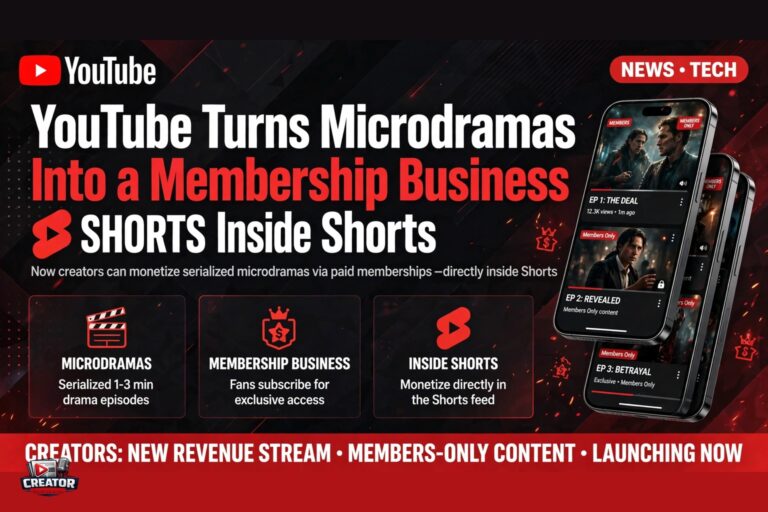
YouTube is done treating microdramas as a passing short-form trend. The company says the serialized vertical dramas passed 6.5 billion views in the first half of 2026, up more than 50 percent year over year, with the strongest momentum in the Asia Pacific region. Now it is building the payment plumbing to match the viewing numbers.
In the coming weeks, YouTube will revamp the mobile viewing experience for members-only episodes. A viewer who hits a locked episode will be able to join that channel’s membership and keep watching the next episodes without leaving the content they are already watching. YouTube stated the change plainly: viewers will be able to easily join a channel membership to keep watching the next episodes without having to leave the content they are enjoying.
That one design decision changes the economics of a Short. A cliffhanger only converts if the paywall shows up at the exact moment the viewer wants the next episode. Sending that viewer out to a channel page, a membership menu, and back again loses people at every step. Keeping the join inside the viewing session turns suspense into a checkout.
Shorts Series gave the format its shelves
The membership change builds on Shorts Series, announced at the Made on YouTube event last month. Shorts Series lets creators group Shorts into seasons and episodes instead of leaving each installment to fight its way through the feed on its own. Together, the two updates give vertical video the structure television has always had: episodes in order, seasons that can be finished, and now a members-only tier for viewers who want the rest of the story.
For creators, the opportunity is not simply more views. A single viral Short pays once, through ads, and moves on. A serialized story with gated episodes can pay three ways at once: ad revenue on the free episodes, membership income from viewers who join to continue, and a back catalog that keeps working after launch week.
The long tail is the quiet headline
YouTube also shared numbers that should change how creators think about episode one. Forty percent of microdrama views and 30 percent of clicks arrived more than 30 days after the videos went live. In YouTube’s own words, Episode 1 keeps finding new fans and earning ad revenue long after premiere week.
That is a different shape from most short-form content, where a post lives or dies in its first 48 hours. A series opener behaves more like a pilot episode in a streaming catalog. Every new viewer it collects is a potential binge, and every binge now ends at a membership prompt instead of a scroll into someone else’s feed.
Translation is doing the distribution work
YouTube credited its auto-translation tools for part of the format’s growth. Multi-language audio, AI-generated local subtitles, and localized metadata let a series shot in Tokyo or Seoul find an audience in Brazil without extra dubbing costs, according to the company. For independent creators, that matters more than any single feature launch. A microdrama team can now produce in one language and sell memberships in several, using tools that used to require a localization budget only studios could afford.
YouTube published its own playbook
The company also shared what it says successful microdramas have in common. The list is specific: emotional hooks in the first 15 seconds, vertical-first composition, high-frequency publishing, and story arcs that center on everyday experiences. YouTube added that some creators are using interactive storytelling, inviting the audience to share feedback on character decisions and plot points, which turns comment sections into part of the writers’ room.
None of that requires a studio. It requires a repeatable premise, a posting cadence a small team can sustain, and episodes written so that each ending sells the next one. The creators who treat Shorts as a season, with the first episodes free and the payoff behind membership, are the ones this update was built for.
The competitive context is hard to miss. Instagram spent this week pushing longer video with its Features test, and TikTok has its own microdrama momentum. YouTube’s answer is not a new format. It is a storefront inside the format it already has, pointed at the viewers who have already decided to stay for one more episode.
Sources
Social Media Today, Andrew Hutchinson, October 27, 2026, YouTube adds microdrama subscriptions: https://www.socialmediatoday.com/news/youtube-adds-microdrama-subscriptions/872982/
WeRSM, Marcel D., updated October 28, 2026, YouTube Is Turning Microdramas Into a Subscription Opportunity: https://wersm.com/youtube-microdrama-subscriptions/
WeRSM, Marcel D., updated September 28, 2026, YouTube Turns Shorts Into Episodic TV With Shorts Series: https://wersm.com/youtube-turns-shorts-into-episodic-tv-with-shorts-series/
Join the conversation
Load Facebook comments to read and reply using your Facebook account.
