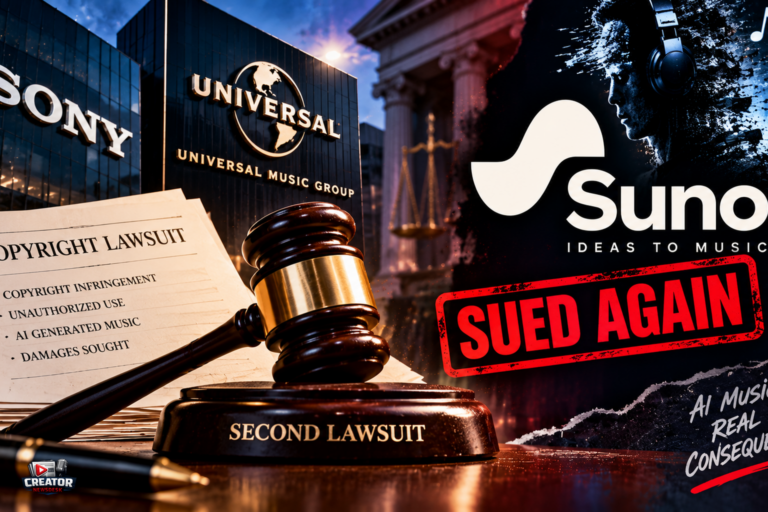
Sony Music and Universal Music Group have filed a second copyright lawsuit against Suno, this time targeting the AI music company’s new v6 models just days after their September 9 launch. The 45-page complaint, filed September 18 in Massachusetts federal court, accuses Suno of infringing more than 60,000 sound recordings and argues that v6 remains tainted by its connection to earlier models.
The labels’ theory is novel and has a memorable name: “model laundering.” They argue that training a new model on the outputs of an earlier, allegedly infringing model does not eliminate the infringement but launders it, passing the value of the copied recordings through the old models, into their outputs, and from those outputs into v6. The complaint also adds a stream-ripping claim, alleging Suno bypassed YouTube’s anti-downloading protections to acquire training audio. At the statutory maximum of $150,000 per work across 60,202 recordings, the theoretical exposure exceeds $9 billion, though actual damages in any case could differ dramatically.
The filing follows a procedural split. The labels had sought to add tens of thousands of recordings to their original June 2024 lawsuit, but in August 2026 a federal judge declined to expand that case on that scale, opening the door to this parallel action. Warner Music Group, an original plaintiff, settled last year and has since licensed its catalog to Suno, leaving Sony and Universal as the remaining major-label plaintiffs.
Suno disputes the claims, maintaining that training generative AI on copyrighted music can qualify as fair use and that v6 was built on licensed partner content, community interactions and its team’s learnings. The company has also admitted that YouTube audio was used in training, and it lost a 2026 case brought by Germany’s GEMA while facing a separate suit from Canada’s SOCAN.
For creators, the key point is what this case is not: it does not make using Suno illegal, and it does not establish that Suno users are infringing. The dispute concerns the developer’s training lineage, not your outputs. The durable takeaway stands regardless of how the case resolves: control what you upload, avoid copying protected expression or deceptively imitating performers, document your human contribution, and check your distributor’s current terms before release.
Join the conversation
Load Facebook comments to read and reply using your Facebook account.