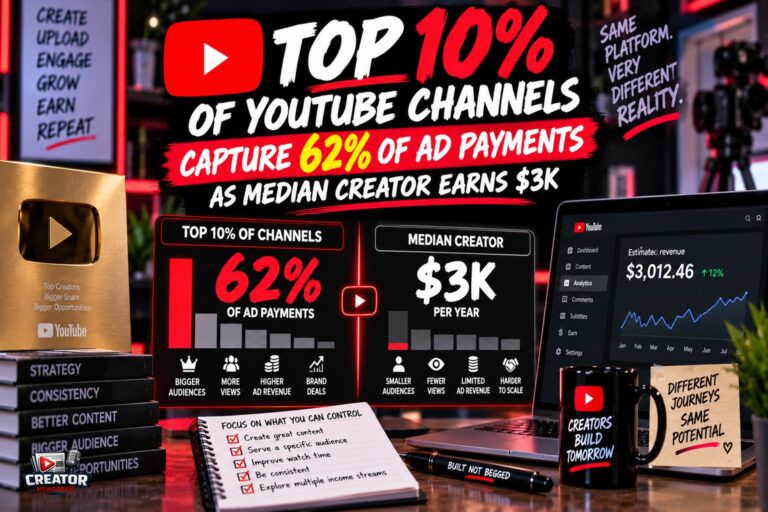
The creator economy’s growth is real — and so is its inequality. The top 10% of YouTube channels captured 62% of all 2025 ad payments, per YouTube’s own reporting cited by FanVault, while the median creator earns approximately $3,000 per year, down from $3,500, according to the 2026 market analysis from IdeasWiz.
The pattern repeats across platforms. On Roblox, the top 10 creators averaged $65.7 million each over the year ending June 2026 while the median of 42,000+ DevEx participants received about $1,500. On OnlyFans, 5,076 creators have crossed $1 million in lifetime earnings — a real achievement, and a tiny fraction of the platform’s millions of creators. A September 2026 creator economy report found the sector grew 26.5% to $323.48 billion even as 56% of full-time creators still earn below a living wage.
Economists call this superstar theory: platform-mediated markets concentrate income at the top because algorithmic discovery amplifies small differences in quality or timing into enormous differences in reach. YouTube’s own numbers confirm it — total creator payouts keep climbing (over $100 billion across four years) while the median creator’s ad income compresses.
The structural response is the shift toward direct-to-fan revenue. FanVault’s analysis argues the marginal stable creator dollar now comes from a fan’s card, not an ad auction: subscriptions, memberships, tips, digital products and paid communities price the relationship rather than the impression.
For creators, the inequality data is not discouraging — it is clarifying. Ad revenue is a lottery ticket; direct fan revenue is a business.
The takeaway for creators: stop optimizing for the average and start building for the top decile’s playbook — owned audience, recurring revenue, diversified income streams. The platforms pay the most to creators who need them the least.
Join the conversation
Load Facebook comments to read and reply using your Facebook account.