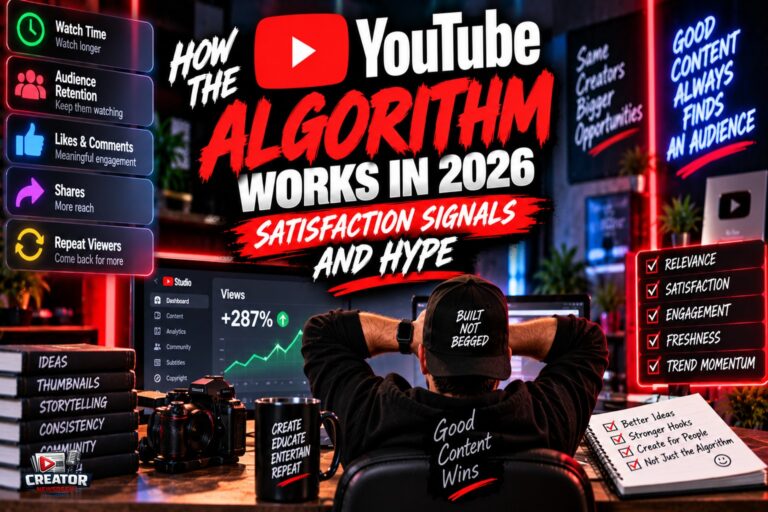
YouTube’s 2026 algorithm ranks videos primarily on satisfaction rather than raw watch time, a distinction that changes what creators should optimize. The system weighs whether viewers got what the title and thumbnail promised, whether they kept watching more videos afterward, and what they report in the platform’s satisfaction surveys. The pattern the algorithm rewards most is a viewer who watches, engages and continues into two or three more videos; the pattern it punishes is the click, twenty seconds, and bounce.
Discovery has also fragmented by format. YouTube Shorts run on a fully independent algorithm from long-form, which means experimenting with Shorts carries no downside risk to the main channel, and Shorts increasingly surface in search results alongside long-form videos. Every upload is evaluated fresh against interest clusters rather than coasting on subscriber counts, so a new channel can break out in days while an established one can stall.
The Hype feature added a structural advantage for small channels in 2026. Viewers get three free Hypes per week, resetting Monday, to push videos from channels with 500 to 500,000 subscribers onto category leaderboards visible to non-subscribers. The scoring favors small channels heavily: a 500-subscriber channel earns 7,500 points per Hype versus 50 for a 500,000-subscriber channel.
The takeaway is to engineer for satisfaction signals directly. Deliver the title’s promise in the first 30 seconds, study retention graphs as maps of exactly where viewers leave, publish the strongest video early in the week when Hype allotments refresh, and ask viewers for Hypes explicitly. The algorithm is not a lottery; it is a satisfaction meter with the rules published.
Join the conversation
Load Facebook comments to read and reply using your Facebook account.
