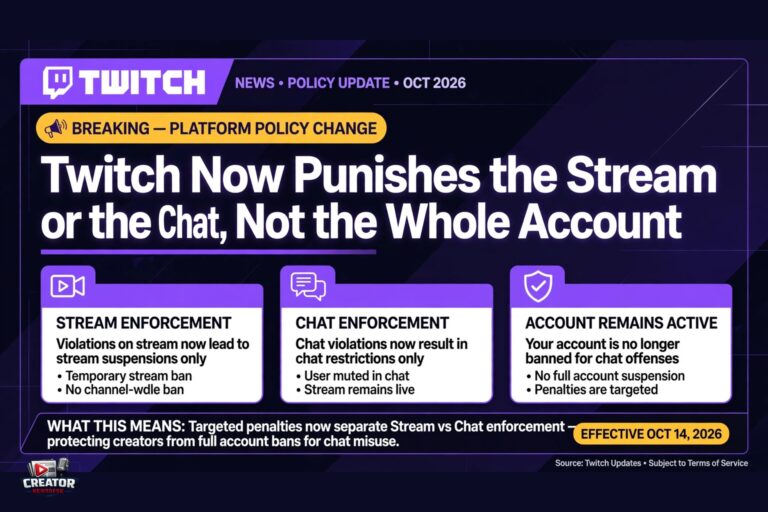
A suspension on Twitch used to mean losing everything at once. A creator who broke a rule in chat could lose the ability to stream, watch other channels, and even open basic account information for the length of the penalty. That all or nothing approach is gone, and this week Twitch put fresh numbers behind the system that replaced it.
In an interview published by Net Influencer on October 30, 2026, Christine Weber, Twitch’s Chief Technology Officer and global Head of Trust and Safety, walked through the targeted suspension system the platform rolled out earlier this year. Temporary suspensions now come in two separate forms, a streaming suspension and a chatting suspension, and the penalty is matched to where the violation actually happened. “People make mistakes. It happens. We just tell them they can’t chat for a while,” Weber said.
What each penalty actually does
A streaming suspension follows a violation during a broadcast or in channel content such as panels. The creator cannot go live, and chat on their own channel is temporarily disabled. They can still log in, watch other streamers, chat in other communities, and open their creator dashboard, according to Twitch’s original announcement of the change in February 2026, reported at the time by Game Rant.
A chatting suspension works the other way around. It follows a violation in chat, and it bars the user from chatting in other people’s streams. The creator can still stream their own content, and they can still talk in their own channel’s chat, so a penalty earned as a viewer does not silence them in front of their own community.
The lengths have not changed. Targeted suspensions still run from 24 hours to 30 days, and repeat violations inside a window that runs from 90 days to two years draw longer penalties. Stacking up too many temporary suspensions can still end in a total platform ban.
Severe violations still get both
The split is not a softening across the board. Weber said severe violations that pose the greatest risk to community safety receive both a streaming suspension and a chatting suspension at the same time. Twitch ranks violations by the level of harm involved, which it defines across physical, emotional, social, and financial harm. The most serious offenses still bring an indefinite suspension and a complete loss of access. At the low end, a streamer whose broadcast crossed a line can receive a streaming suspension as short as a day.
Every penalty now arrives with an explanation of what the user did wrong, and Weber framed that feedback loop as the point of the redesign. Education, not just removal, is the stated priority.
The numbers Twitch is citing
The case for the lighter touch rests on Twitch’s own internal data. According to Weber, only 2 percent of active users have ever received a suspension, and 90 percent of those users never reoffend. She credited streamers and their communities for those figures.
Repeat behavior is handled by escalation rather than by a single heavy penalty. “If you continue to do it again and again, well, the consequences escalate. Kind of like getting a speeding ticket,” Weber said. She tied the design to how Twitch views its creators, as entrepreneurs growing a career, on a service with five million streamers live each month and more than 100 million viewers a month.
Warnings before penalties
The suspension split sits on top of a broader education layer. Twitch runs a prompt that asks a chatter whether they really want to send a message that looks questionable, giving them a second chance before anything is posted. Weber said the platform has found that prompt effective, in part because many people do not realize how their wording will land. Risky messages can also be held for a moderator to approve or reject.
On the automated side, AutoMod scans chat in real time and blocks messages Twitch can identify as harmful with a high degree of confidence. Live content decisions, though, stay with people. “Our content is live, and determining whether something from a stream is violative involves nuance that AI just can’t account for consistently,” Weber said. Viewer reports fill the remaining gaps, and Weber said a moderation staff working around the clock triages them, handles the most harmful first, and deals with more than 80 percent of them in under 10 minutes.
Creators still own their chat
One responsibility has not moved. “A streamer is responsible for what happens in their chat,” Weber said, with chatters sharing that responsibility. Twitch’s community guidelines are the floor, and creators can build stricter rules on top. When trolling starts, Shield Mode can slow chat or restrict it to subscribers with one click. Weber also noted an influx of creators who started livestreaming on other services in the last couple of years, and said Twitch reports back to them after streams with a picture of the broadcast’s safety posture, so the expectations are explicit.
For working streamers, the practical change is simple. A bad moment in chat no longer has to cost a week of broadcasts, and a broadcast violation no longer locks a creator out of the rest of the platform while they serve it. The penalties still escalate, the severe cases still end careers on the service, and Twitch is now arguing, with its own reoffense data, that most people only need to be told once.
Sources
Net Influencer, Cecilia Carloni, October 30, 2026, “Twitch Splits Suspensions Into Streaming And Chat Penalties, Citing Data On Low Reoffense Rates”: https://www.netinfluencer.com/twitch-splits-suspensions-into-streaming-and-chat-penalties-citing-data-on-low-reoffense-rates/
Game Rant, Ashley Turner, February 25, 2026, “Twitch is Making Even More Changes to How It Handles Bans and Suspensions”: https://gamerant.com/twitch-bans-suspensions-changes-2026/
Join the conversation
Load Facebook comments to read and reply using your Facebook account.
