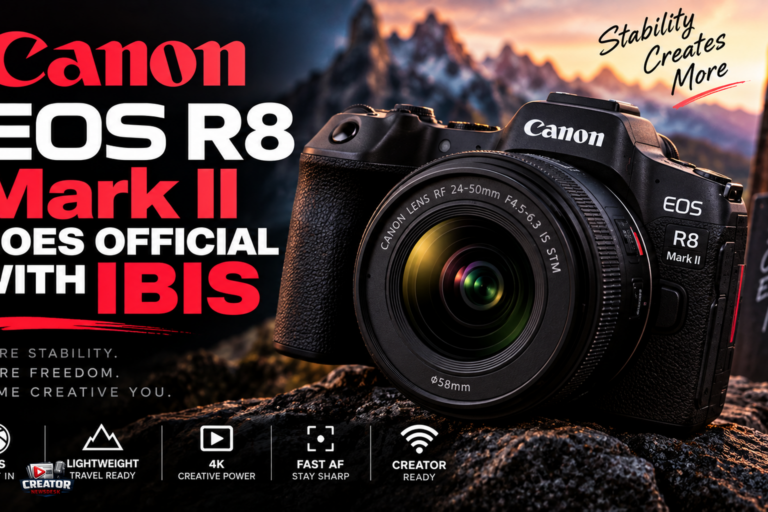
Canon has made the EOS R8 Mark II official, refreshing its compact full-frame mirrorless camera with in-body image stabilization, a 24.2-megapixel full-frame sensor and Dual Pixel CMOS AF II. Priced at $1,899 body-only or $2,099 with the RF 24-50mm f/4.5-6.3 IS STM kit zoom, it is available for pre-order now.
The headline upgrade is IBIS, which the Mark II claims as the lightest EOS body with in-body stabilization. For video creators and hybrid shooters, stabilized full-frame capture in a compact body addresses the most common complaint about the original R8, which relied entirely on lens stabilization. Combined with Canon’s Dual Pixel autofocus, the Mark II is positioned as a walkaround hybrid that can handle both stills and video without a gimbal for most situations.
The kit configuration tells the story of the target buyer. The RF 24-50mm f/4.5-6.3 IS STM is a compact, modest-aperture zoom, and an optional extension grip is available for shooters who want a meatier hold. This is a camera for creators stepping into full-frame from APS-C or phones, not for professionals replacing a cinema body.
The R8 Mark II lands in a busy season for approachable full-frame. Nikon’s viewfinder-less Z5IIC chases the same first-time buyer at a lower price, and Panasonic’s compact L-mount primes are building out the lightweight full-frame ecosystem from the lens side. Canon’s answer leans on its traditional strengths: color science, autofocus and the deep RF lens catalog.
For creators, the takeaway is to evaluate the Mark II against your stabilization needs. If you shoot handheld video and have been working around the original R8’s lack of IBIS, the upgrade is meaningful; if your work is tripod-bound or you already own stabilized RF glass, the difference narrows. Either way, test the IBIS with your actual lenses before committing, since stabilization performance varies more in practice than on the spec sheet.
Join the conversation
Load Facebook comments to read and reply using your Facebook account.
